
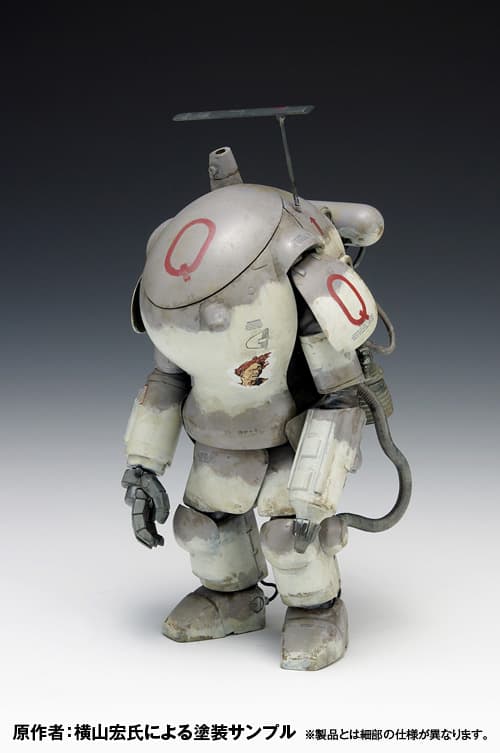
Ma.K. has appeared in Japanese model magazines since the 1980s, and its distinctive painting techniques and diorama photography gave it a visual language of its own. More than forty years later, modellers continue to build models from the series, and Yokoyama himself remains active on social media. To long-time followers, the armoured suit standing behind the products in FUTURE RELIC WORKS' promotional images was not anonymous set dressing. It was a recognisable work from Yokoyama's series.
What began as an ordinary new-product announcement turned into an infringement row. The criticism snowballed, and the questions widened: what had the brand actually been selling, what had it shown or sold at the KCF model event, and what was going to happen to customers who had already paid, or already received their goods?
What Happened
Who is FUTURE RELIC WORKS?
FUTURE RELIC WORKS is a retro-futurist 3D-printing brand operated by Shinichi Inamori (稲森進一), who handled the design, printing and sales. Before opening, he gave prototypes to experienced modellers in the community to paint and brought them to the KCF model show in mid-August. The brand later opened an X account and soft-launched on 22 August on BOOTH, the direct-sales platform for creators.
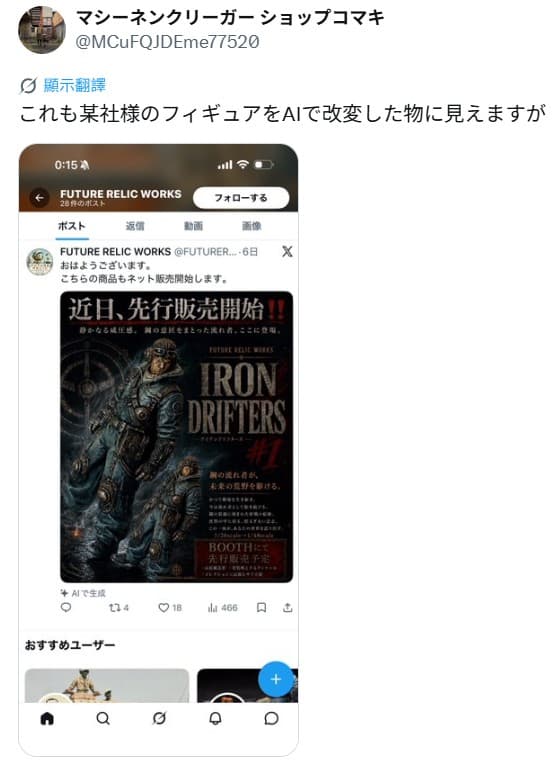
In the days that followed, the brand posted that sales had exceeded expectations, printing was running at full capacity, and the first shipments were being prepared. It was then accused of using Ma.K. models without permission in several promotional images for new products.
The dispute begins: “This is unauthorised use of the design.”
In late August 2026, the Japanese model maker Kow Yokoyama posted two product images on X with one short accusation:
「これって意匠の無断使用です。」 (“This is unauthorised use of the design.”)
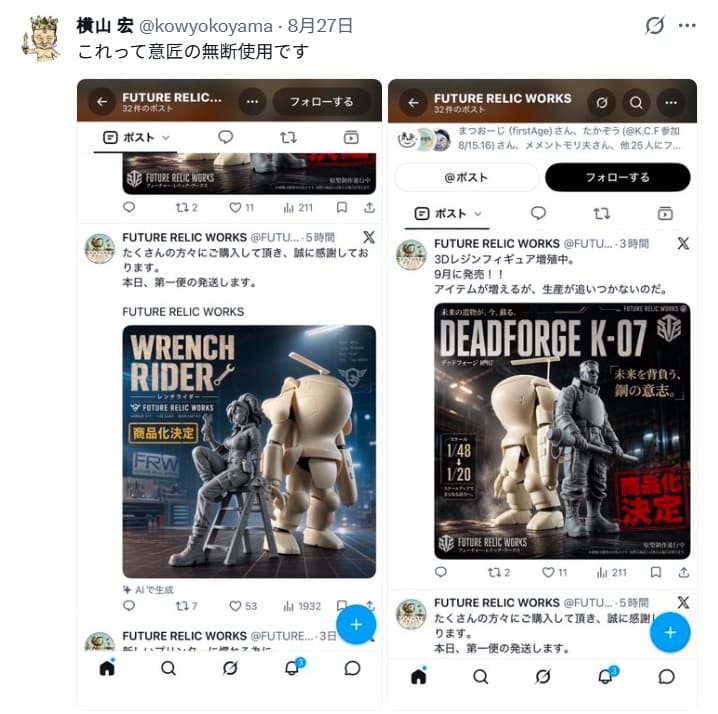
Both images came from the newly opened FUTURE RELIC WORKS. In the foreground were the brand's own small figures; behind them stood a familiar spherical armoured suit. Not a nameless sci-fi prop built for the shot, but a Fireball-type machine from Yokoyama's Maschinen Krieger ZbV 3000 series.
Images deleted, apology posted — and then? Questions spread and full refunds follow
FUTURE RELIC WORKS deleted the images and apologised in the replies almost immediately, but the discussion did not end. Some users reviewed the brand's earlier posts, questioned the sources of other “original” designs, and asked whether unauthorised copies had been sold at the show. The discussion expanded from two promotional images to the brand's other products and event activities.
The brand's first response, under Yokoyama's post, was brief:
「無知で申し訳ございませんでした。全て削除致しました。本当にすいませんでした。」 (“I am sorry for my ignorance. I have deleted everything. I am truly sorry.”)
Yokoyama followed up at once: hadn't the products already been sold and shipped before the images came down?
FUTURE RELIC WORKS replied that the models shown in the disputed images had not been sold or shipped. That did little to satisfy anyone, because the original product post had already thanked the many people who had bought, and said the first batch would ship that day.
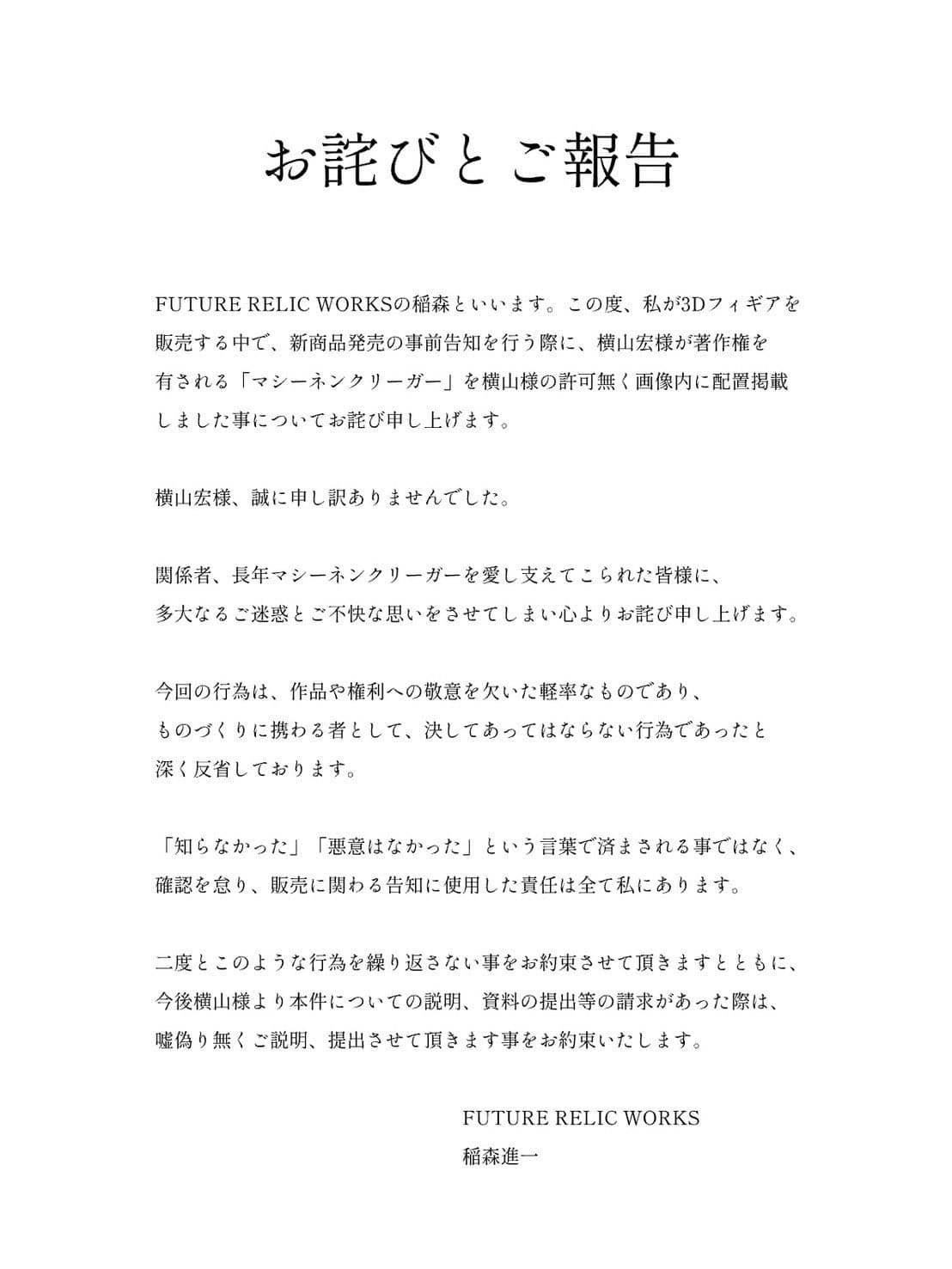
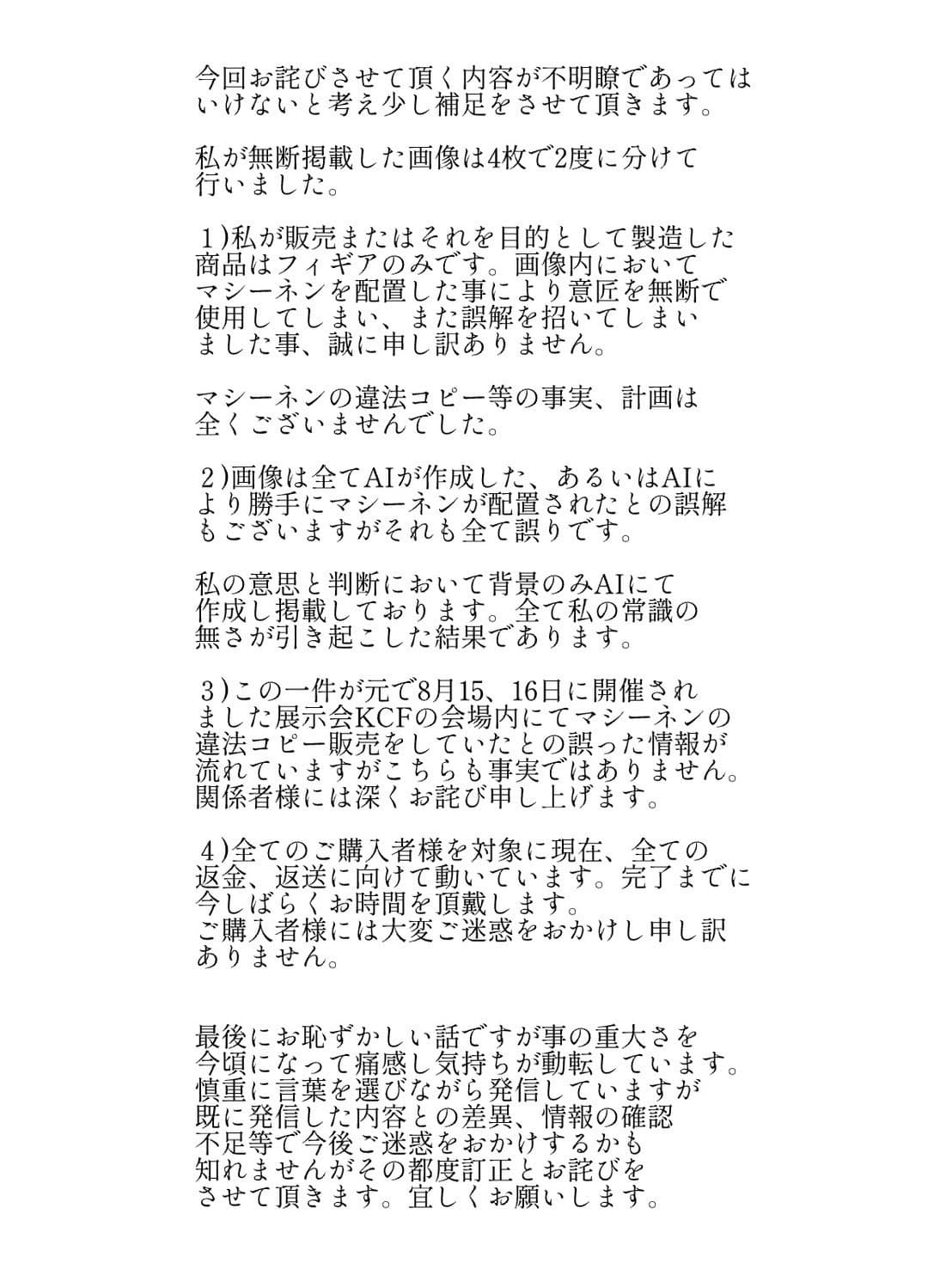
With the row still escalating, FUTURE RELIC WORKS published its first full written apology on 30 August. Inamori admitted that, while selling 3D models, he had placed a Ma.K. work in which Yokoyama holds copyright into a promotional image announcing a new product, without permission. He said his conduct showed a lack of respect for the work and for the rights in it, and that for someone who builds models himself it was a careless act that should never have happened. He wrote:
Neither “I didn't know” nor “I meant no harm” makes this all right. I failed to check, and I used the material to promote a sale. The responsibility is entirely mine.
He undertook not to repeat the conduct, and said that if Yokoyama asked for an explanation or for documents about the matter, he would answer truthfully and provide them.
On the second page of the statement he added four points addressing the community's questions. First, four images had been published without permission, in two batches; the only goods he had manufactured, or manufactured for the purpose of sale, were his own figures, and he denied having produced or planned to produce unlawful copies of Ma.K. Second, the disputed images were not entirely AI-made, and the Ma.K. armoured suit had not been generated or placed automatically by AI — he had chosen and placed it himself. Third, he firmly denied the claim circulating online that unauthorised copies had been sold at the KCF event in mid-August. Fourth, he announced returns and full refunds for all purchasers, not limited to the products shown in the four disputed images.
On 1 September the brand said it had used BOOTH's direct-message function to contact customers whose goods had shipped on 31 August, explaining how refunds would work and asking them to send the items back. On 2 September FUTURE RELIC WORKS announced that, because of its own careless infringement, it was asking for the return of every item sold since the 22 August opening.
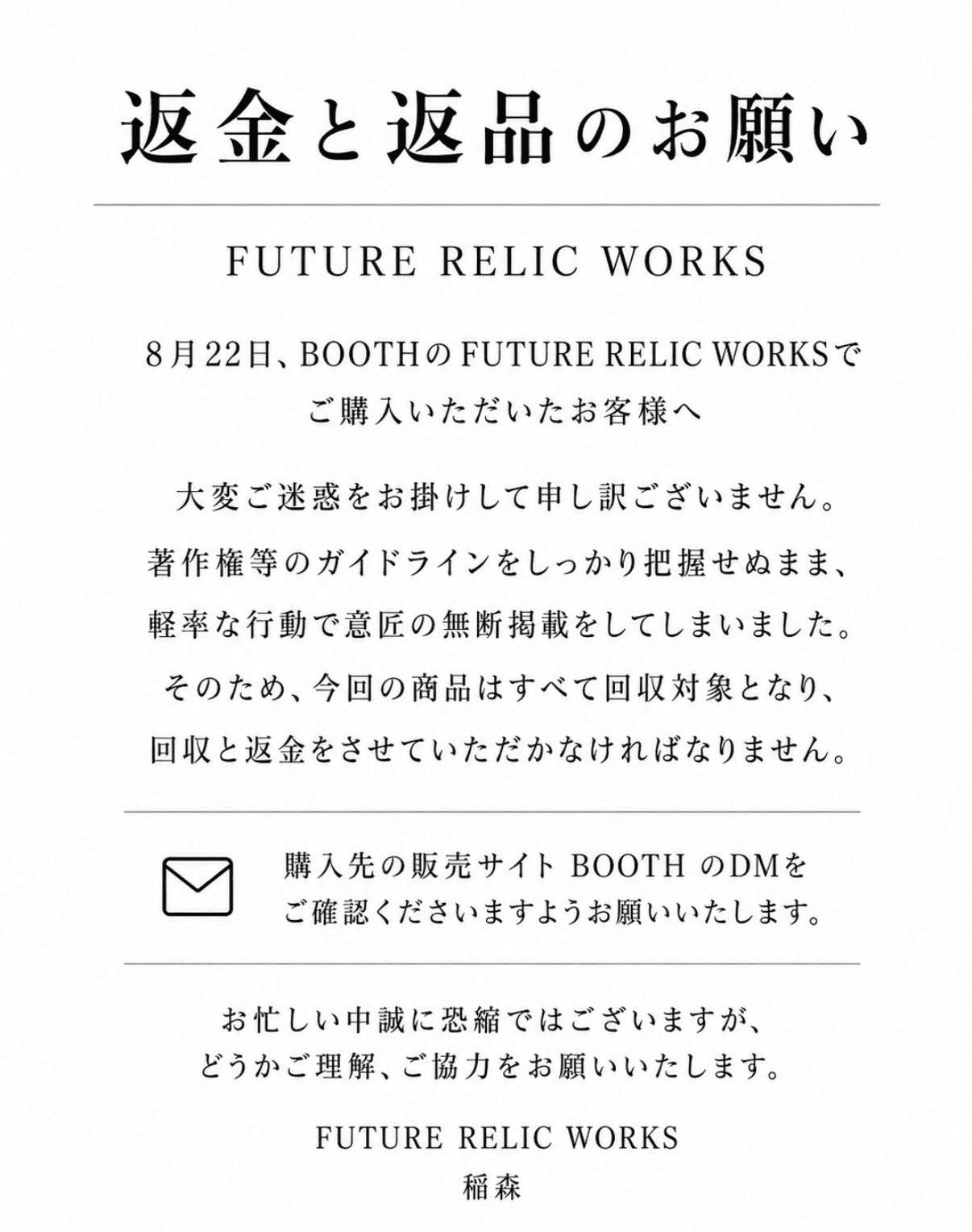
Less than two weeks after opening, the brand was asking every buyer since 22 August to send their goods back for a refund.
If This Happened in Taiwan
If the same scenario unfolded in Taiwan, such disputes typically wouldn't stop at social media backlash, but would directly escalate into concrete legal action. Using someone else's work in commercial promotion without authorisation can attract criminal liability for infringing the right of reproduction under the Copyright Act, and civil exposure under the Fair Trade Act for misleading representations and unfair competition, at the same time.
1. Does a supporting role in an advertisement not count? Commercial gain and the limits of fair use
The moment a brand picks a Ma.K. armoured suit as a compositional element and lets a third party's work carry the world-building in its advertisement, it is already at the heart of the copyright problem. Under the Copyright Act, photographing a protected work clearly into a promotional image, compositing it in, and publicly transmitting that image online is difficult to bring within fair use, and the risk of infringing the reproduction and public transmission rights is correspondingly high.
Newer brands often assume that buying a legitimate, licensed kit and photographing it puts them in the clear. It does not. Buying a lawful model gets you ownership of a physical object; it does not carry with it the right to use that object as a supporting player in commercial advertising and publicly transmit the resulting image online. Fair use exists for comment, news reporting and teaching, not to prop up someone else's commercial activity. Where the purpose is to sell your own goods, the ordinary commercial route applies: get written permission from the economic rights holder.
2. Did the image imply an official licence or collaboration? False association and free-riding under the Fair Trade Act
Once a brand is taking orders, shipping, and announcing new products, the Fair Trade Act comes into play. The useful question here is a simple one: if you removed the Ma.K. armoured suit from the frame, would the advertisement's appeal, and the world it evokes, drop noticeably?
If the answer is yes, and the overall presentation is enough to leave the public with the impression of an official licence or a collaboration, that is a “false or misleading representation” in the legal sense. Worse, using the reputation and appeal of someone else's IP to sell a new product — living off the results of another's work — is precisely the free-riding on goodwill that the law targets. Deleting posts and issuing refunds afterwards limits the damage, but it does not extinguish the civil liability that has already arisen. A trader faces an administrative penalty from the competent authority of up to NT$25 million, damages claims from the economic rights holder, and, where the conduct is intentional, damages that a court may set above the amount proven, up to three times that amount.
The System Worth Keeping: Treat Promotional Material as a Product in Its Own Right
It is easy to assume that, as long as you do not use another party's trademark without authorisation or infringe another party's patent, you are safe. But the Copyright Act's protection of works and the Fair Trade Act's protection of trading order are equally important. Now that it is easy to open a shop online, using someone else's work to promote your own brand may attract attention for a time. The resulting administrative penalties and reputational damage may not be remedied by a refund.
Do not let a missed check become a serious business risk. Make licence verification a standard step before any new product goes live, and confirm the rights status of every asset used in promotional material.
Not sure whether your promotional materials clear third-party rights?
WISECODE advises on copyright clearance, promotional-material review, and Fair Trade Act risk across Taiwan, China, Japan and beyond.